
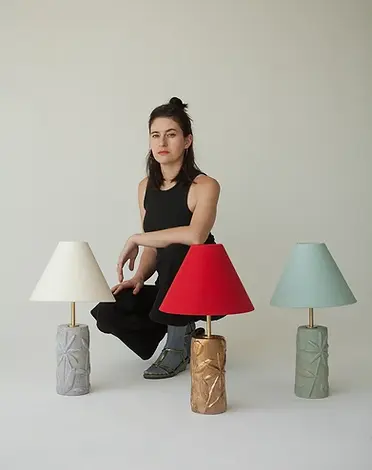
Ariella Kirschbaum
Los Angeles, CA
Ariella Kirschbaum is a ceramic artist and designer who is interested in creating dynamic spaces through her work.
Ariella’s work explores how objects carry emotion, reference nature, and hold a sense of tradition. Her pieces balance subdued vibrancy with restraint, and maintain a quiet intensity. Informed by historical practices, her work often features relief-like surfaces and floral motifs that feel both familiar and contemporary.
She lives and works in Los Angeles, CA, and creates ceramic lighting and ikebana vessels.

A Conversation with the ARTIST
Tell us about your practice and how you came to making?
My friend brought over clay one night and from then on I was hooked. I couldn't stop thinking about it for months. I was a high school teacher at the time, feeling very exerted and contained, and ceramics gave me the freedom I didn’t know I needed. I fell in love with the physicality of it, the way a form slowly emerges, the control the kiln has. Over time what I realized I was doing was catching things – moments from the natural world, feelings that don’t have names, a sense of connection to people and traditions that came long before me. I became interested in how objects hold all of that. How you can pick up a piece and feel something you can't quite explain. That's the center of everything I try to make.
Do you have a ritual when it comes to making/designing work?
Morning is when I'm most alive to it. There's something about that transition that puts me in exactly the right state. Coffee first, then ideally straight to the studio before the day accumulates. Once I'm in it, the process shifts depending on what a piece needs. Sometimes I sketch first, other times I let my hands lead. I draw a lot from fashion and textiles when I'm thinking about glazing, and then there are the walks, the hikes, the camping trips and various travels where I absorb the natural world without any agenda. Music or audiobooks in the background, silence when I need to go deeper. The ritual isn't really a fixed set of steps. It's about creating the conditions where something real can come through.
Floral motifs appear throughout your work. What draws you to these forms, and how does nature shape the way you think about pattern, texture, and surface?
Flowers feel like a kind of universal language, present in decorative traditions across every culture and era, and yet never exhausted. I was actually really resistant to them at first because of how used they are, but that is what my hands kept leading me to, so I went with it. For me, they're about catching something that's always moving. A flower exists in time in a way that's almost unbearably beautiful. It blooms, it passes, it means something. Clay lets me make it stay. Nature is my most constant reference. It's about the feeling that the living world belongs inside the spaces we inhabit.
Can you tell us about the Nocturne lamps? Their sculptural form, metallic surface, and small floral bead-like adornments give them a playful, almost magical presence. How did this series come to be?
The Nocturne lamps came from a very specific and personal moment. My husband and I spent a month on our honeymoon sleeping under the stars, by a river, near a field of wildflowers. There was a quality to those nights I wanted to hold onto: the quiet, the intimacy, the feeling of being completely surrounded by nature and by someone you love. The form is solid and grounding, while the surface is where everything blooms: the metallic glaze, the small floral details, light spilling from both the top and bottom. I wanted the lamps to make the feel of a space sacred in a quiet way.
Color plays a major role in your pieces. How do you approach glazing and developing your palettes, and what guides your decisions when choosing color for a particular form?
Light does something extraordinary to ceramic surfaces. It finds the texture, deepens the glaze, shifts the whole feeling of an object across the course of a day. Ceramics is so often understood as solid and still, but introduce light and suddenly the material becomes alive. With lamps, the piece stops being just a sculptural form and becomes a source of atmosphere. It holds the light and gives it back differently. The idea that an object can change not just how a space looks, but how it feels to be inside it, that's what I'm always reaching for.
Is there anything you’ve dreamed of making, but haven’t yet?
Always. The dream list is long and there is never enough time or enough hands. I think a lot about scale: large ikebana-inspired planters and full tiled spaces where the ceramic language becomes the environment rather than an object within it. The idea of a space that you step inside rather than a piece you pick up, where the detail and the feeling are everywhere at once. That's the direction the bigger dreams tend to go.
What’s next for you?
My style has been shifting quite a bit lately, and I’m putting a lot of energy into nurturing that. I’ve been learning and experimenting with new (to me) woodworking techniques to move my work forward, particularly into furniture. However, lamps will always be at the top of my to-make list—I have too many ideas to ever stop making them!