
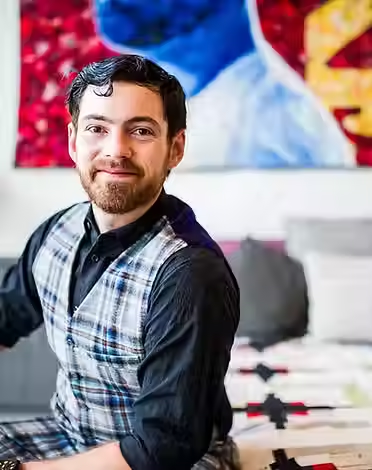
Luke Haynes
Asheville, NC
Luke Haynes is a textile artist who redefines quilting within contemporary fine art. Working exclusively with salvaged textiles, he creates large-scale portraits, quilted structures, and immersive installations that blur the boundaries between craft, architecture, and public art. His work explores structure, repetition, and material systems while transforming reclaimed fabric into sculptural, architectural compositions. Haynes expands the possibilities of quilting as both material practice and cultural form.

A Conversation with the ARTIST
Tell us about your practice and how you came to making?
I make quilts and textile-based work, often using recycled clothing and traditional quilt structures as the foundation. My practice grew out of necessity, curiosity, and a need to make sense of the world. I grew up with very little, so making things from what was available felt natural to me. Quilting gave me a way to create order, beauty, and meaning from scraps. My work still comes from that original push, taking what has been discarded or overlooked and turning it into something lasting.
Do you have a ritual when it comes to making/designing work?
Not really, mostly I just try to finish what I start. That, to me, feels the most important because it completes the idea and teaches me things I didn't know to learn.
Every piece you make comes from salvaged textiles. Beyond the environmental commitment, what does a material with a prior life bring to the work that new fabric doesn’t?
A salvaged textile already has a story in it. It has been worn, washed, stretched, stained, loved, outgrown, or given away. That history matters to me.
New fabric can be beautiful and helpful to manage exact color matching, but used fabric carries evidence of life. When I cut it apart and rebuild it into a quilt, I’m not erasing that past. I’m letting it become part of the new creation. It brings warmth, texture, and a design based on the community that discarded it in the first place.
You came to quilting when you were a teenager, and you’ve described it as a practice that built structure and stability. How do you think quilting continues to create structure or stability in your life or in the larger context of its historical practice?
Quilting still gives me a system to return to. There is math in it, repetition, order, problem-solving, and a clear relationship between one piece and the next. For me, that structure is calming. I also think that has been part of quilting’s larger history. Quilts have often been made in moments when people needed warmth, resourcefulness, memory, beauty, or connection. They create stability not only because they are useful objects, but because they hold people together through making, storytelling, and care.
Your practice stems from a personal place, but it’s now very public facing. How does the narrative or composition of your work change as you’ve taken on more public projects?
The work has become more aware of where it lives. In the studio, a piece can be very internal and specific. In public space, I have to think about how someone will encounter it while walking by, driving past, gathering near, or living with it every day.
The core of the work is still personal, but the composition opens up. Scale becomes important. Distance becomes important. The story has to be readable in layers, with something immediate from far away and more detail for someone who comes closer. Public work has taught me to think about quilts not just as objects, but as part of an environment and a shared experience.
You pioneered a unique approach to portrait quilting, for which you’ve been widely recognized. What brought you to develop this part of your practice and how has your relationship to the style changed over twenty years of working with it?
I came to portrait quilting through wanting to see how far the medium could go. I was interested in taking something familiar and traditional, like a quilt, and using it to build an image in a way people didn’t expect. Portraiture gave me a way to push fabric into detail, likeness, and storytelling.
Over twenty years, my relationship to it has gotten more spacious. At first, I was focused on proving what was possible technically. Now I’m less interested in the technique as a trick and more interested in what it can hold. The portrait method is still important to me, but it’s one tool inside a much larger practice about material, memory, structure, and place.
You trained as an architect at Cooper Union and then returned to textiles as your primary medium. What did architecture teach you that you may have carried back into quilting? What crossovers do you observe between architecture and quilting?
Architecture taught me to think about structure, scale, space, and how people move around an object. Even when I’m making something soft, I’m still thinking architecturally. I’m thinking about weight, geometry, pattern, and how the piece will live in a room or public space.
Quilting and architecture have a lot in common. Both are built from repeated units. Both depend on systems, measurements, and joinery. Both can create shelter, memory, and a sense of place. Architecture gave me language for the built world, but quilting gave me a way to make that language warmer and more human.
Is there anything you’ve dreamed of making, but haven’t yet?
I want to do all the quilts for a hotel or large-scale living space. I also want to create some of my quilt architecture in more museum lobbies.
What’s next for you?
EVERYTHING! I am still growing and learning and trying new things.