
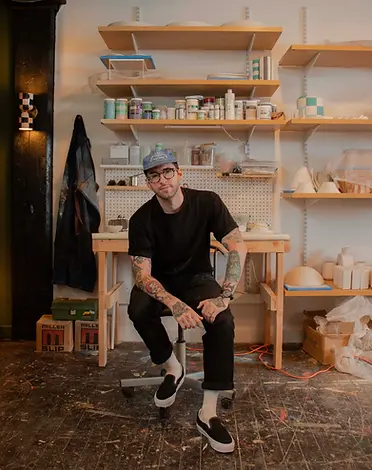
Streicher Goods
Brooklyn, NY
With a background in graphic design, Ethan Streicher brings a love of geometric forms and modern aesthetics to his work. Working primarily in ceramics, his pieces—from lighting to handmade furniture—combine sculptural elements with functional design, infusing interiors with warmth, tactility, and a quiet, human presence.

A Conversation with the ARTIST
Tell us about your practice and how you came to making?
My current practice is focused on creating larger ceramic furnishings for the home. I hand-built every piece that comes out of my studio, using mostly slab building techniques, and some coil building or slip-casting when needed.
I started doing ceramics 6+ years ago as a hobby to get away from the monotony of sitting at computer and work with my hands—fast-forward to Spring 2024, and I quit my full-time job as a Graphic Designer to invest more time in building the ceramic business and focus my energy on my artistic practice. (Basically I wanted to have fun!)
Do you have a ritual when it comes to making/designing work?
I don’t know if it’s ritualistic, but I have a process for how I approach designing pieces. I start off with small thumbnail sketches of a key idea to explore form and various ways of executing. From those quick pencil sketches, I place a star by my favorites, then draw 2D versions of them in Adobe Illustrator (side view) to nail down specific proportions. This step is huge because it allows me to make sure my sketches and final scale of my piece are aligned. Then, I get into the actual building of the piece once I know what dimensions I’m working with.
Your work explores texture, color, pattern, and form — there's a lot of variables at play at once. How do you navigate that experimentation, in its early stages and again when you feel like the piece is almost finished?
Most of the ideating is done in the beginning, so when I get into making the piece, I already know how I want to balance form, where texture will be, or if I’m leaving the piece mostly blank to let the glaze shine through. There are times where I make those decisions on the fly though, for instance, if while building a piece I feel like there is something missing, I’ll try a few quick techniques to see if one helps add visual intrigue to the work.
Choosing what glaze to use on a piece, especially if it’s the first time I’m making it, feels like the biggest challenge. I just sit looking at the piece, drinking my coffee, picturing different glazes I like on it until my mind goes ‘duh, it’s that one.' Once the piece is glazed and fired, there’s no going back… only making it again.
Your background in graphic design seems present in the geometric and visual precision of your pieces. How does your design training actually show up in your studio practice, and is there ever tension between the graphic instinct and the tactile, handmade nature of ceramics?
I’m happy my geometric inclination / precision is apparent! The computer is so exact, and I do quite a bit of planning in illustrator ahead of time to figure out where break lines will be (where slabs of clay will stack), and overall dimensions. But once I get into making, I allow for my work to show my hand. I’m not a robot after all. There will also be some markings from my hand, a wobble, imperfections in a brush-line, carved areas that are not perfect, etc in the pieces, and that’s the human, hand-made element that I never want to get rid of.
When you first made the switch from graphics to building, what was that experience like?
I always felt like leaving the office to go to the clay studio was like a gear shift mentally. I could be exhausted from design work, but when I got to the studio, where I was using my hands versus looking at a screen, I’d get a new burst of energy.
The transition from graphics to ceramics wasn’t a hard one, but I’d be lying if I didn’t say it was somewhat scary going into “the unknown”. I saved up some runway money, told myself “give yourself the year at least” and then never looked back (which realistically, one year is not long enough haha). The real challenge was me being in charge of my own time, goals, and what work to make. That was challenging, and still is. I’ve learned a lot about myself through the process of managing myself, my time, and my work.
Lighting makes up a significant part of your practice. What drew you toward light as a material to work with — not just as a functional element, but as something with its own expressive possibilities?
I wanted to explore functional ceramics, but hate making cups or plates, so I decided to start making some lighting for my house. I loved the idea of using this object I had made to change up the mood of space.
I think my mind also likes a brief (which is probably from my design days). It helps me focus my thinking—picture it like a list in front of me of where to start, versus a blank sheet of paper. If I go “design a sconce” I can start to think of all the different ways to make a shape, hide the bulb, make the bulb a part of the design language, bounce the light, etc. It sort of sparks the process.
The 'Turn Me On lamp' is covered in switches, only one of which actually works. What was the seed of that idea, and what have you observed when people encounter it for the first time?
That lamp is such a fun one, and it’s very gamified. Kids love the thing! And adults love to figure it out, then pull their friend over to try their hand at it.
That lamp was inspired by an article I’d read about whimsically annoying or badly designed objects. I’m forgetting who the designer was, but the jist was like a teapot that when you went to pour it, the neck was bent back into the top, so the liquid could never leave, or a fork whose points were bent back towards your hand.
Reading this led me to the idea of making a lamp covered in switches, but originally, I wanted the lamp to have an Arduino machine. The machine would re-route the power to a new switch every time the piece was turned off, so every time you went to turn it on, you’d have to figure out which switch turned it on. Sadly, I’m not good at coding, so I had to go with 1 switch to rule them all. If you know, you know.
Is there anything you've dreamy of making but haven't yet?
I’ve been making bigger and more technical works lately, pushing myself and understanding the medium even more at larger scales. I’d love to make larger solid ceramic furnishings, but I’m limited by my kiln size and the space I have here in Brooklyn. So a dream of mine would be to have access to a very large kiln and maybe be part of a residency program during that time to continue learning.
What's next for you?
I think I’m interested in creating more intricate side tables and creating whimsical furniture. I’ve definitely found myself leaning back into exploration more lately, and still figuring out 'what Streicher Goods is.'
Coming up in May, I’ll be showcasing a lot of these new creations at Afternoonlight for Design week, which will highlight some new side tables, large coffee tables, lamps, and a blending of materials I had not yet worked with.