

Tammy Mata-Lasky
Brooklyn, NY
Tammy is an interior designer interested in the unexpected design that emerges when working with existing materials—a refreshing change to the predictable results of fabricating new things based on set specifications. Using reclaimed materials to breathe new life into vintage pieces presents a process for making one-of-a-kind pieces of furniture that are kinder to the planet, connected to a past, and feel very human.

A Conversation with the ARTIST
Tell us about your practice and how you came to making?
I think drawing really was the foundational thing for me and what I always come back to today. As a kid, it was a way to entertain myself, process the world, and dream up the stuff I wanted to make but did not know how to–like outfits for my Barbies.
Eventually, I went to architecture school because I wanted to have a practical outlet to be creative. Working in architecture, I discovered an interest in interior design which then sprouted into a love of furniture design and collaborating with other makers. I have a painting practice that I try to keep alive alongside this. It’s really great food for paying attention and being intuitive.
Do you have a ritual when it comes to making/designing work?
I get a cup of coffee, put on some music, maybe light a candle, and take frequent little dance breaks.
What draws you to working with reclaimed materials?
It hurts my brain to think of things piling up in landfills. How can we keep creating new things without replenishing and transforming existing materials at an equal rate? Working in interior design, I see how there are so many amazing materials that go to waste like samples, mockups, scraps, and leftovers. So, it’s really satisfying to find ways to make these things useful again.
You described a process where reclaimed materials themselves may reveal how they want to be used. How did that play out with the gem stool — and were there moments where the materials took you somewhere you didn't expect?
Yes, definitely some unexpected moments. Because the materials were collected over time, I could not plan out exactly how they were going to be used. I had collected a plush celadon mohair scrap I really liked. It was juicy and lush, but the fabric was too bulky to wrap tight corners with and the high pile was awkward for weaving things into. Then, I got access to some yardage of green velvet from the de-installation of an exhibit at Allen Street Gallery. It was a much better thickness for wrapping corners, and it lent itself more easily to stitching in other fabrics and charms.


As an interior designer, you’re accustomed to specifying and directing the making of objects, but aren’t usually doing the actual production yourself. What was it about this particular footstool that made you want to cross that line — and had you ever made work like this before?
This was my first upholstered work. I considered getting an upholsterer to do it, but realized I needed to play around with the materials I was collecting in a much more exploratory and unplanned way, rather than directing set specifications. The footstool is a small enough object that it felt achievable to figure out how to upholster on my own. I kind of embraced that there would be a naiveness to the work since I was approaching this as a novice. The preciousness would not come from a mastery of craft but rather an accumulation of care and attention.


When you first pitched this piece it hadn’t yet been constructed. You used the phrase "Bohemian-regal Olsen twin" to describe your vision for it, which, as interior designers, totally landed for us. Now that it’s a completed physical object in the world, how close did it land to your original intention? Is there anything about the finished product that the mood board couldn’t have predicted?
The original fabric on the thrifted stool was a folksy weave that reminded me of something regal like a tapestry. The fabric was really dingy and in need of repair, but it served as a good muse and ended up being incorporated in the final piece.
I was also in the middle of designing my engagement ring. All these references of gem stones, collages, and assemblages kept coming up for me. I kept getting excited by the idea of experimenting with how jewelry could be used in upholstery. I ended up collecting charms and beads that were used as embellishments and a stay chain for the fliptop lid.
The Olsen Twins might be on my mood board for life generally. They are such a source of inspiration for many reasons, but for this project in particular, they represented an idea of layered styling rich in contrasts and unexpected pairings.
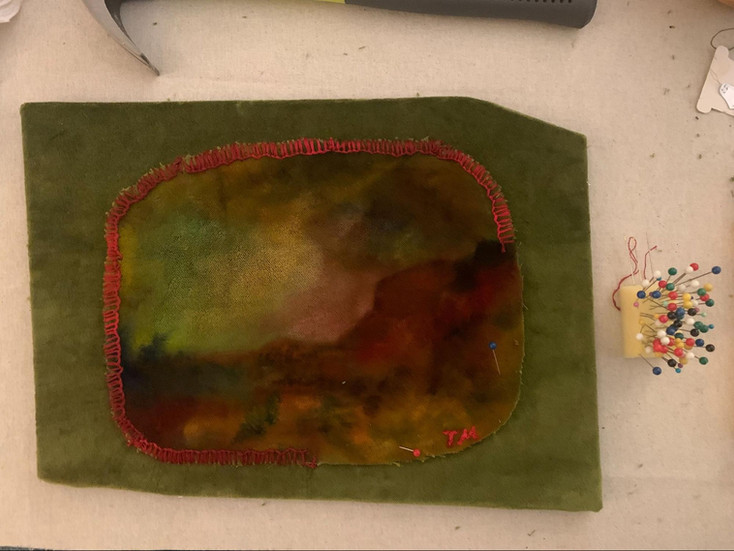
One thing I really didn’t expect was the painted landscape I added to the inside of the compartment. When I was stripping the wood frame of the original stool, the wood reminded me of a moody old-world landscape painting. The idea kind of popped into my head at the very last minute to paint this image into the fabric at the bottom of the compartment, kind of like a portal or postcard from another time.
Ultimately, I think I did stay true to the moodboard, although the finished product is not something I could have imagined in advance.


You came into this exhibition with the hope that it might be a testing ground for a larger practice. Did making this piece confirm anything, complicate anything, or open up a direction you hadn't considered before?
It confirmed that I can take a chance on design work with reclaimed and collected materials where the path is not known. It also confirmed that it takes a lot of work outside of regular work to make these ideas happen, but it felt worthwhile. Storage space for collecting materials is also complicated within a cramped Brooklyn apartment.
What’s next for you?
I’ve been obsessing over quilts. I bought a quilted housecoat from the 1940s at a flea market, and ever since then, I can’t stop noticing quilted design. It’s been in my mind for some time that I’d like to experiment with quilting as a medium for upholstery. I think it would be interesting to capture some of what I find so alluring about quilts into the places we sit by upholstering a thrifted chair with a vintage quilt.