

Taussen Brewer
Newburgh, NY
Taussen Brewer is an artist, educator, and community organizer living and working in Newburgh, New York. She grew up in Tulsa, Oklahoma and received her BFA from Alfred University. Taussen has exhibited her work internationally from New York to Mexico City. Currently, she teaches and manages a community studio in the Hudson Valley called The Newburgh Pottery where she also makes work that is both sculptural and for the table. She is also an active member in community arts organization through groups like Patchwork Studios, a small member run art space that centers eco-social engagement. Taussen is the recipient of several awards like the Lisa Elwell Ceramic Artist Endowed Encouragement Award.
Joy and playfulness are central to Taussen’s work. Her hand-built, one-of-a-kind ceramic vessels explore color and form, offering a fresh perspective on what ceramic objects can be. Drawing inspiration from nature, her pieces reflect the beauty and spontaneity of the natural world.

A Conversation with the ARTIST
Tell us about your practice and how you came to making?
I started making art at a young age, though I didn’t discover ceramics until my mid-twenties. I was fortunate to attend a small charter school focused on the arts and sciences, and I always knew I wanted to be an artist. But it wasn’t until I took my first ceramics class that I felt a deep connection to a material. What drew me in was the tactility and intimacy of clay — there was something immediate and grounding about it that completely hooked me. That relationship to the material continues to shape all of my work. In that first class I learned tile work and handbuilding, and I found myself constantly daydreaming about the sensation of clay and all the things I wanted to make with it. I knew then that I had found something truly special.
Do you have a ritual when it comes to making/designing work?
My practice is very sacred to me, so I try to give myself the proper time and space to create each body of work. I’ve just come out of a long resting period where I hadn’t made anything for several months. Over the past few years, I’ve found myself moving in rhythm with the seasons. Winter becomes a time for rest and reflection, while Spring is when ideas begin to come alive again.
The tableware and more outwardly functional pieces tend to feel less conceptual, so the process of making them is more meditative. The larger, more ornate works tap into broader conceptual ideas and feel much more ritualistic when bringing them into the world.
What attracted you to working in clay and specifically hand-building?
There is something less precious about clay than, for instance, making a mark on paper. It’s both a forgiving material and one that constantly asks you to come to terms with loss and error. When I touch clay, there’s something deeply grounding about it. a kind of brain-to-hand connection or we could just call it clay magic that immediately pulls me into the process. It has a way of completely absorbing my attention. Hours can pass while I’m still fiddling with a single detail. At every stage, whether the clay is plastic, wet and pliable, or leatherhard, there are so many points of entry and refinement. What I love most about hand-building is that it allows me to slow down and disappear into that space of close looking, patience, and noticing finer details.
There are a lot of connections to nature and the domestic in your work. Can you talk more about what you are inspired by?
Growing up in Oklahoma, my parents spent a lot of time antiquing, so I was constantly going to estate sales and auctions with them. Many of the objects they collected were pottery, especially pieces from McCoy Pottery. I grew up surrounded by objects that carried a sense of history — things that were considered rare, valuable, or meaningful because of the stories attached to them. I think that experience deeply shaped the way I understand objects and the narratives they can hold, especially everyday domestic objects.
The plant-life references in my work are both decorative and meant to give the pieces a sense of movement and life. Each object may suggest function, but ultimately they exist as reflections of a worldview in which all elements of nature are alive and interconnected. I’m inspired by a wide range of visual languages: folk art, Pre-Columbian art, ancient artifacts and symbology, and many other traditions. I’m deeply interested in the spiritual relationship objects can hold in connection to the mysteries of life.
When it comes to glazes and your color palette, you have a wide range of colors. How do you develop your glazes? Is there something that feels instinctual with each unique piece?
I use a variety of commercial glazes, recipes from the internet, and a number of bases that I can alter with colored stains. Typically I am looking at individual pieces for color schemes but occasionally, I will glaze a body of work with the same colors. I like for there to be a balance of color while also using an assortment of glossy vs. matte to create contrast and depth.
Your work often has delicate hand-built appliques of clay that feels reminiscent of quilting or feltwork. Is there a reference here to sewing in some fashion that is coming through your collection?
I actually look at quilts a lot. The Gee’s Bend quilts are some of my favorite works of all time, and I think that influence naturally finds its way into some of these appliqué decisions. I often reference them for color and pattern. Taking a quilt-making class has been on my list for a while now, so I imagine that connection to sewing and textile work will only continue to grow in the work.

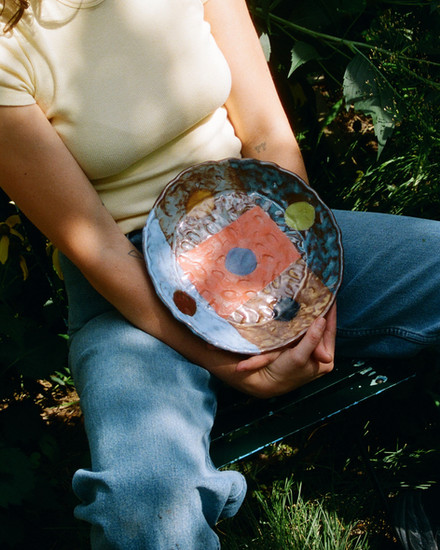
With the time consuming nature of hand-building, and the large scale of much of your work, what is the firing process like for you? Is there ever a fear that these very large, detailed pieces won’t make it through the kiln?
I fire in electric kilns, which are pretty reliable in terms of speed and consistency. There is always a fear that things won’t survive or that they won’t come out looking like I planned for them to. Things do break but I have gotten pretty good at problem solving repairs and building the work in a way that that prevents cracking or breakage. A big lesson I have learned is to never rush the process!
Is there anything you ever dreamed of making, but haven’t yet?
The list is endless! I have years of work living in my head that I want to make but some of it remains incomplete or just isn’t ready to come into the world yet. I love building large scale. The difficult thing about that is having the space to put it. One day when I have my own studio these bigger things will come to fruition I hope.
What’s next for you?
Right now, I’m working on a new body of work that builds on last year’s tulipières. The forms are becoming increasingly intricate, and I’m excited to see where that direction leads. Even bigger news: my partner and I are expecting a baby at the end of the year. I can only imagine how much this will reshape both my life and my work as an artist, but I’m optimistic that it will open up new perspectives and take me to places creatively that I wouldn’t have arrived at otherwise.