
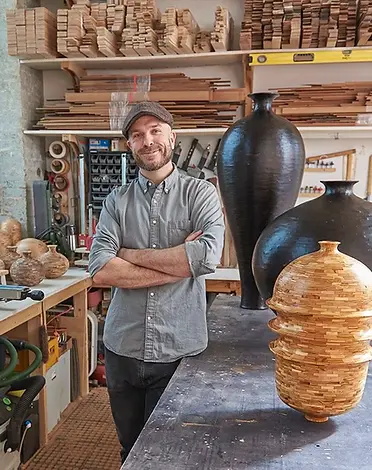
Richard Haining
Brooklyn, NY
Richard Haining is an artist, sculptor, and studio furniture maker committed to the intersection of sustainable design and fine craft. Raised in Atlanta, GA, and educated at the Rhode Island School of Design, living in Brooklyn NY since 2008 and a full time practicing artist for the past 10 years.
Richard's work is driven by the concept of renewal—transforming salvaged materials into functional & decorative art that embodies beauty, craftsmanship, & environmental mindfulness.
He challenges the conventional idea of waste, finding inherent value in what others discard. These materials are found in various shapes & conditions, requiring significant time to transform it into something usable. Then, piece by piece, layer by layer, he guides the wood into its desired shape, akin to a coiled ceramic pot. Once constructed, he refines the surfaces by hand, revealing imperfections: mineral stains, contrasting heartwood and sapwood, knots, century-old nail holes—marks of the wood’s history. The proverbial Phoenix rising from the ruins.

A Conversation with the ARTIST
Tell us about your practice and how you came to making?
I have always been been obsessed making. As a child I loved Legos, Constructs, Blocks, anything that could be assembled and taken apart and then renvisioned into something new again. Early on my folks taught me that if you don’t like what you’re given, learn to make it better. That lesson took form through everyday making: gardening, where the taste of a warm, home-grown tomato could never be found in a grocery store, and cooking, where sharing a home-cooked meal fostered community and lasting relationships. I considered going to culinary school, but after a year of working in a restaurant in my late teens, I realized that I loved to cook, but it was not my professional calling.
I decided to go back to college and fell in love with art, and transferred a year later to RISD. It was here where I was introduced to the work of influential artists and makers whose philosophies continue to shape my practice. George Nakashima’s concept of the Soul of a Tree deeply resonated with me, urging me to approach wood not as a mere material, but as a living entity with its own unique character and history. I was also inspired by Wendell Castle’s innovative use of stack lamination and his hand-carved sculptures, which opened my eyes to the potential of craftsmanship to create both functional and sculptural forms. In addition, the environmental and process-driven work of Andy Goldsworthy, who uses natural materials in their raw state to craft temporary installations, encouraged me to rethink the relationship between artist, materials, and place. These foundational ideas—respecting materials, embracing their imperfections, and creating with intention—have deeply influenced my artistic practice.
I was fortunate to study under remarkable furniture makers (including Rosanne Somerson, Peter Walker, Lothar Windels, Jim and Mel Cole, Don Miller, John Dunigan, Peter Dean, and Dale Broholm) who instilled in me a respect for my craft and a consciousness about the materiality of my work. In particular, my time working alongside these skilled artisans cultivated in me a sense of responsibility for the materials I chose, including what would often be considered "waste." It was here that I developed my respect for the potential embedded in every scrap of wood, and that my relationship with wood itself evolved into something much more intimate and profound. It was during this period that I truly fell in love with the medium and began to understand its endless possibilities.
Do you have a ritual when it comes to making/designing work? Where do you find inspiration?
New York City provides me with endless inspiration. My practice is rooted in renewal, and this City is not only my home but it’s also my collaborator. I work with wood salvaged from across the city—from fabrication offcuts to old-growth lumber reclaimed from pre-war buildings, even from the decommissioned NYC water towers that crown our skyline. Pulled from dumpsters and demolition sites, it’s not waste but living archives shaped by generations of hands and use. These materials carry the imprint of labor that sustains our city long before they reached my studio.
By building objects from these overlooked fragments, each work preserves the physical and cultural memory embedded in this salvaged wood, celebrating the traces of labor, habitation, and time, and functioning not only as sculptural forms but also as a quiet acknowledgment of the communities and material histories that continue to shape life in New York City.
How did the STACKED collection first take shape? What did those early experiments look like, and how has the series evolved since?
Initially, I turned to scrap wood due to lack of financial resources. I was working as a carpenter and fabricator in Brooklyn’s set industry, serving the advertising, fashion, and event sectors. Unlike art, the projects we created for clients were often ephemeral, meant to last only for a brief moment before being discarded. The sheer volume of waste produced in the process—large quantities of materials thrown away after just a few days of use—was staggering and, frankly, maddening. This experience sparked a turning point in my mind.
I began salvaging discarded materials, particularly quarter-inch plywood, and saw in this humble, often overlooked material the possibility of creating something greater. From those scraps, I began building large scale “vessels” (two feet in diameter and 3’-4’tall…big). This practice of reimagining discarded materials became the foundation of my signature style.
By taking small, overlooked pieces, using then as a building block, and reassembling them into new forms, I found a way to create beauty and meaning from what was otherwise considered waste. This exploration of materials and sustainability continues to drive my work, where every piece tells a story of transformation, responsibility, and reverence for the materials at hand. I made 5 of these large vessels and from there I realized I could use this same process to create virtually anything. Given enough material, and enough time, while working within the properties inherent to wood (i.e. expansion/contraction) I can create almost anything.
This material other people deemed “waste” was in my eye perfectly good, it just required a bit more time and patience to create the finished piece. I love that my process allows me to create something that cannot be found in nature. There is no burl or figure that will ever match the mosaic quality my finished pieces take on. Unlike segmented work, I have no preplanned math. Since I build piece-by-piece, layer by layer, the result is an insanely beautiful random patterning. My choice of sculpting the exterior of each piece by hand (there is no lathe work on any of my work) results in a finished surface with subtle undulations similar to that of hand built pottery.
The making of the Carpel Vessel
Your pieces appear seamless, yet they’re constructed from many individual components that build the larger form. How does the STACKED process compare to more traditional woodworking methods — particularly in terms of labor, time, and precision?
My work is wildly time intensive. I build each object entirely by hand through a slow, additive process I call stacking. Forms emerge incrementally—piece by piece, layer upon layer—like coil-built ceramics or an analog form of 3D printing. This meditative method allows intuition to guide the work, revealing the final form through accumulation, repetition, & sustained attention.
Each piece becomes a record of time, decision, and care. Surfaces are shaped and refined entirely by hand, without the use of a lathe. Though they may appear precise, subtle variations and gentle undulations remain—marks that quietly register touch and affirm the presence of process.
Wood is often associated with rectilinear forms, yet your pieces lean into curves and softened edges. What draws you to using this type of language in your work, and what does it allow you to express?
The natural world is full of flowing curves, the bend in a river, the curl of seedling bursting through the dirt, the way a tree branch meanders for open sky. Unlike traditional wood workers who use dimensional timber fresh from a lumberyard, I am using tiny blocks to reassemble into the form I wish to create. From the jump, I’m not working within the limitation of square boards. Instead of turning a vessel from a giant log, or cutting a curved element from a bigger board, I additively sculpt the vessel, the arm of a floor lamp, or the frame of a mirror. I feel my approach is not limited to square, so it leans the opposite direction.
The making of on of Richard's floating consoles
The finishes on your pieces range from bone white to near black. How do you achieve these more distinct wood finishes, and how do you decide what surface treatment a particular form calls for?
It all depends. Typically, I do prefer natural finishes for my work, I like to let the natural colors of the wood, and the shifting patterns created by heartwood juxtaposed to sapwood, mineral stains from decades of use.
That said, I do at times treat the wood. There’s a cedar I’ve used quite a bit that is quite plain in color, it doesn’t have much variation. I treat that wood with fire, using the Japanese YakiSugi technique which results in a chameleon quality; in direct daylight, the tones are deep maroon cognac tones; but in low lighting, the tones take on a much darker, virtually black coloration. I personally don’t like that Maple yellows over time, so I’ve developed a treatment that creates a bone-white finish. And, sometimes, I want the silhouette to be the focus. In that case, I use ash with a Sumi Ink finish which is “dead black”.
Is there anything you’ve dreamed of making, but haven’t yet?
Every work I create leads to another “aha” moment, informing me of what else is possible. The early vessels led to me thinking of circles which resulted in creating a mirror. Those circles also led me to creating my coffee tables, seeing the smooth outsides juxtaposed to the terraced/faceted inside. Those led me to thinking, which if I was to break the circle and make linear elements, which led to my floor lamps. Those led to my early chandeliers. Those led me to implementing some more traditional joinery to create my more elaborate 10 Bulb Chandeliers.
At present, I really want to work on larger objects. Scaling up the finished work, while keeping the individual blocks tiny, I believe will quite dynamic and increase the overall visual impact.
What's next for you?
In between commissions, I always try to have a handful of pieces I am building on spec. Ideas I have in my head, but until I create them, no one else will know that it’s possible. So, at present, I'm creating a five and a half foot diameter chandelier in Walnut and an 8’ tall floor lamp made of California Redwood (from those decommissioned NYC Water Towers). I’m also looking forward to Spring and getting out into the woods.
